Yetagun
A fixed-platform gas-and-condensate development in Myanmar’s Taninthayi offshore area, in about 105 metres of water. Production started in May 2000. A wellhead platform feeds a processing platform for gas treatment and condensate separation; compressed gas leaves through a dedicated export pipeline to Thailand, while stabilized condensate is transferred to a permanently stationed floating storage and offloading vessel for tanker export.
Operator: Petronas
Status: Operational
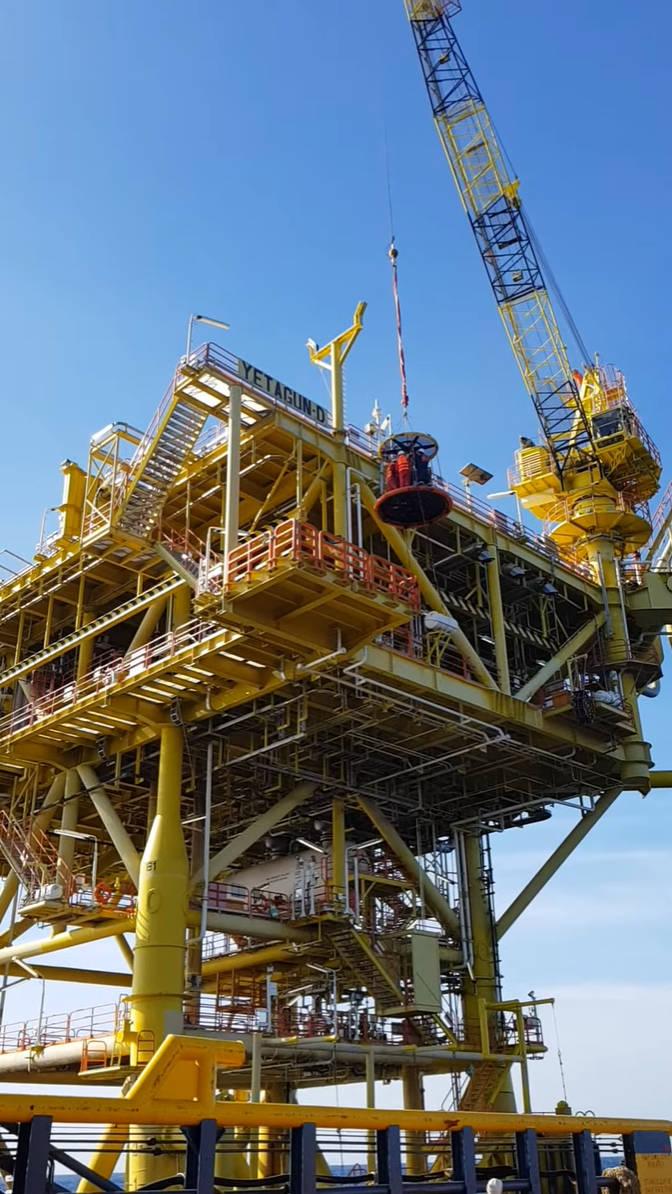
Image Source: Wikipedia: Yetagun gas field. (All rights belong to the original owner.)
Production: Gas
Operations start: 2000
Water depth: 105 m
Country: Myanmar
Block: M12, M13, M14
Type: Fixed steel jacket
Field
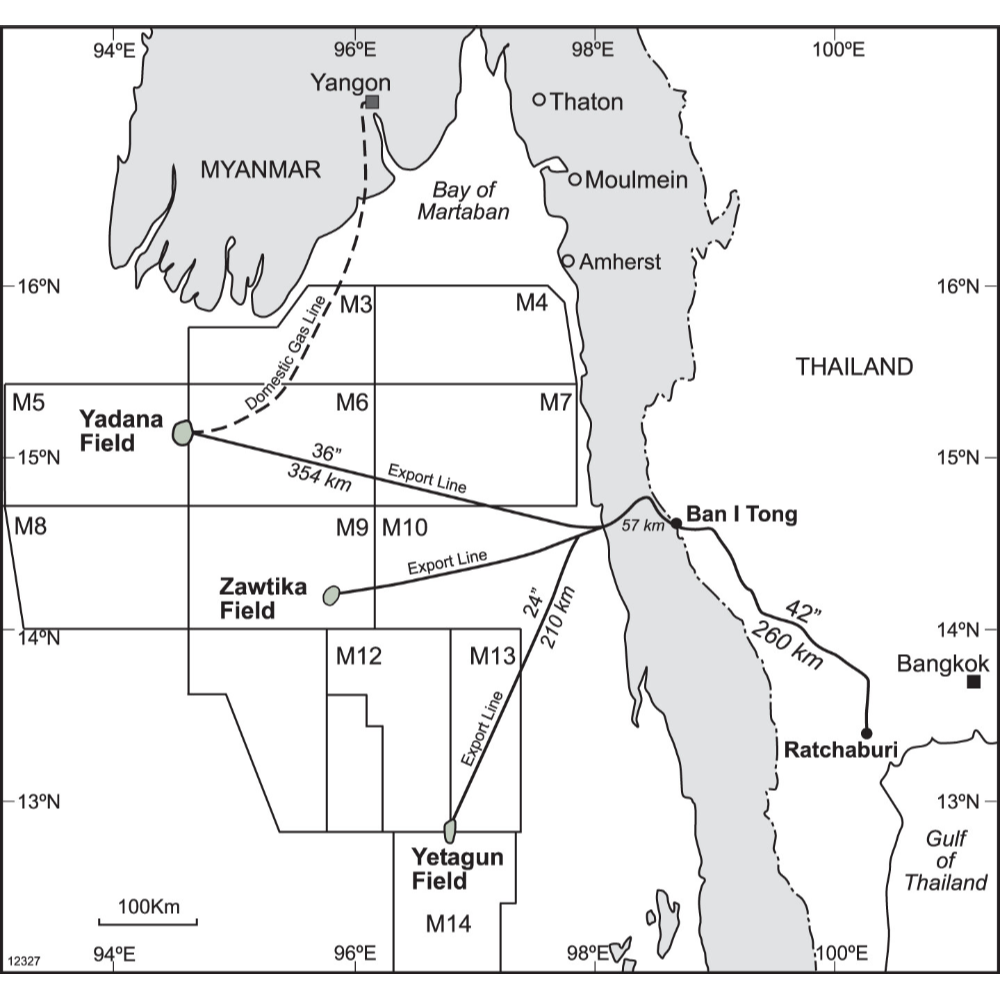
Yetagun occupies Blocks M12, M13 and M14 in the eastern Andaman Sea, also described as the Gulf of Moattama. It is a large gas-condensate accumulation developed by fixed platforms, an export pipeline and an FSO. The hydrocarbons occur principally in multiple Lower Miocene deltaic to shallow-marine sandstone reservoirs within the Taninthayi offshore petroleum province, with reservoir compartmentalisation and variable carbon-dioxide content documented across the area.
Facilities
The base development consists of the Yetagun-A wellhead platform, the Yetagun-B production and processing platform, a booster-compression platform, a gas-export pipeline and the Yetagun floating storage and offloading vessel. Yetagun-A is a multi-slot fixed steel-jacket platform supporting platform-drilled production wells. Well fluids are routed to Yetagun-B, where installed facilities separate gas and condensate and dehydrate the export gas. The permanent booster-compression platform, reported at about 13,700 tonnes, raises gas pressure for the transmission system. Additional satellite wellhead structures are connected to the processing hub through infield pipelines. Dry gas is exported through a 24-inch pipeline system. Public project descriptions identify an offshore section of approximately 202 kilometres and an onshore section of about 270 kilometres continuing to the Thai border, where it connects with the Yadana route. The land system includes a pipeline operating centre and a custody-metering station. Condensate is exported separately through a 6-inch subsea transfer line to the moored Yetagun FSO. The vessel is an approximately 81,000-deadweight-tonne unit with storage for about 606,000 barrels and a single production riser; stored condensate is offloaded to visiting tankers. The architecture separates wellhead, processing, compression and storage functions. Production wells remain on fixed jackets, gas separation and dehydration occur on Yetagun-B, export pressure is provided by the compression platform, and liquid inventory is held on the FSO rather than the processing platform. Permanent pipelines and risers connect these elements into one field system.
Similar Assets
News