Tamar
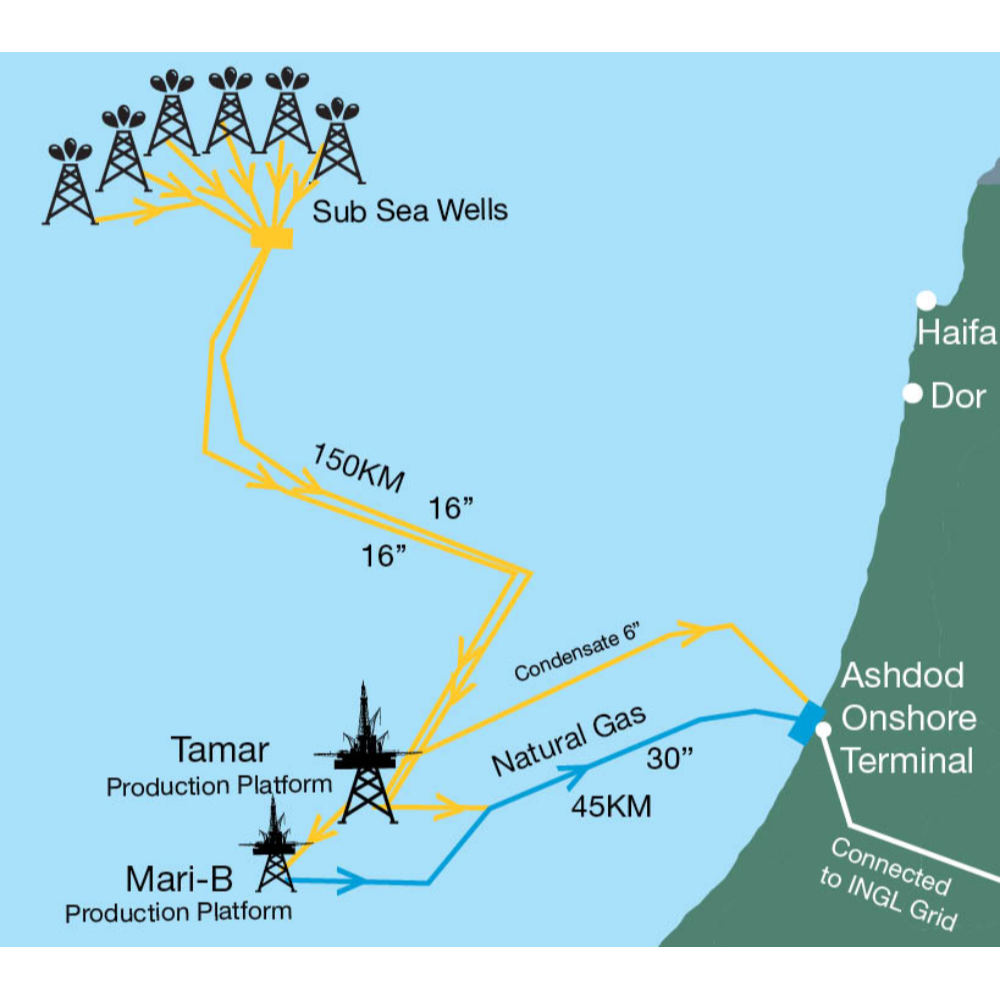
Tamar is a deep-water subsea gas development tied to a fixed treatment and production platform offshore Ashkelon, Israel. Commercial gas delivery began in April 2013. The original development used six subsea wells in approximately 1,700 metres of water, connected through dual 150-kilometre flowlines to a jacket platform approximately 25 kilometres offshore in 234 metres of water.
Operator: Chevron
Status: Operational
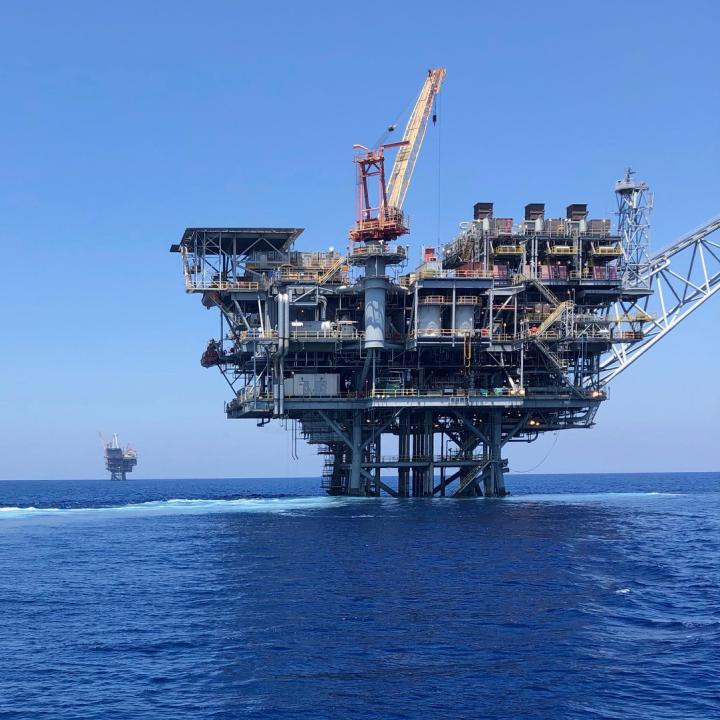
Image Source: https://www.washingtoninstitute.org/policy-analysis/israeli-offshore-gas-platform-near-gaza-resumes-production. (All rights belong to the original owner.)
Production: Gas
Operations start: 2013
Water depth: 1700 m
Country: Israel
Block: I/12 Tamar
Type: Fixed steel jacket
Field
Tamar lies roughly 80–90 kilometres west of Haifa in the Levant Basin. It is a large gas-condensate accumulation within the lower-Miocene Tamar Sands, a stacked succession of deep-marine turbidite sandstone reservoirs. The field is developed as a long-distance subsea tie-back, with seabed wells and a central manifold connected to a shallow-water processing platform and an onshore terminal at Ashdod.
Facilities
The original Tamar production system comprises six subsea gas wells connected by 10-inch well flowlines to a seabed production manifold. From the manifold, gas and condensate travel through two parallel 16-inch pipelines, each approximately 150 kilometres long, to the fixed Tamar Platform. Two 4-inch monoethylene-glycol lines return hydrate-inhibition fluid from the platform, while two 150-kilometre electro-hydraulic umbilicals provide well control, power, communications and chemical services. The Tamar Platform is jacket-supported in approximately 234 metres of water, about 25 kilometres offshore Ashdod and roughly two kilometres north of the Mari-B platform. Topsides equipment separates liquids from the gas, stores, treats and recycles monoethylene glycol, and dehydrates gas using triethylene glycol. Installed systems also include condensate handling, tanks, pumps, air compressors, electrical generators, process control, flare and pressure relief, firefighting equipment, helideck, lifeboats and living quarters. Natural gas leaves through a short 24-inch section connected to a 30-inch pipeline to the Ashdod Onshore Terminal, where final treatment is completed before entry into the Israel Natural Gas Lines national transmission system. Additional 10-inch and 6-inch lines provide gas, condensate and MEG service between the platform and shore. Separate 16-inch gas and 8-inch condensate pipelines connect Tamar with Mari-B. Tamar has no offshore storage or tanker-loading capability.
Similar Assets
News