P-66 FPSO
A purpose-built, ship-shaped replicant FPSO serving the Lula South pre-salt development in Brazil’s Santos Basin. First production began on 17 May 2017. Permanently stationed about 290 kilometres off Rio de Janeiro in approximately 2,150 metres of water, it receives oil, gas and water from subsea wells, treats and stores crude, processes associated gas, supports reservoir injection and transfers oil to export tankers.
Operator: Petrobras
Status: Operational
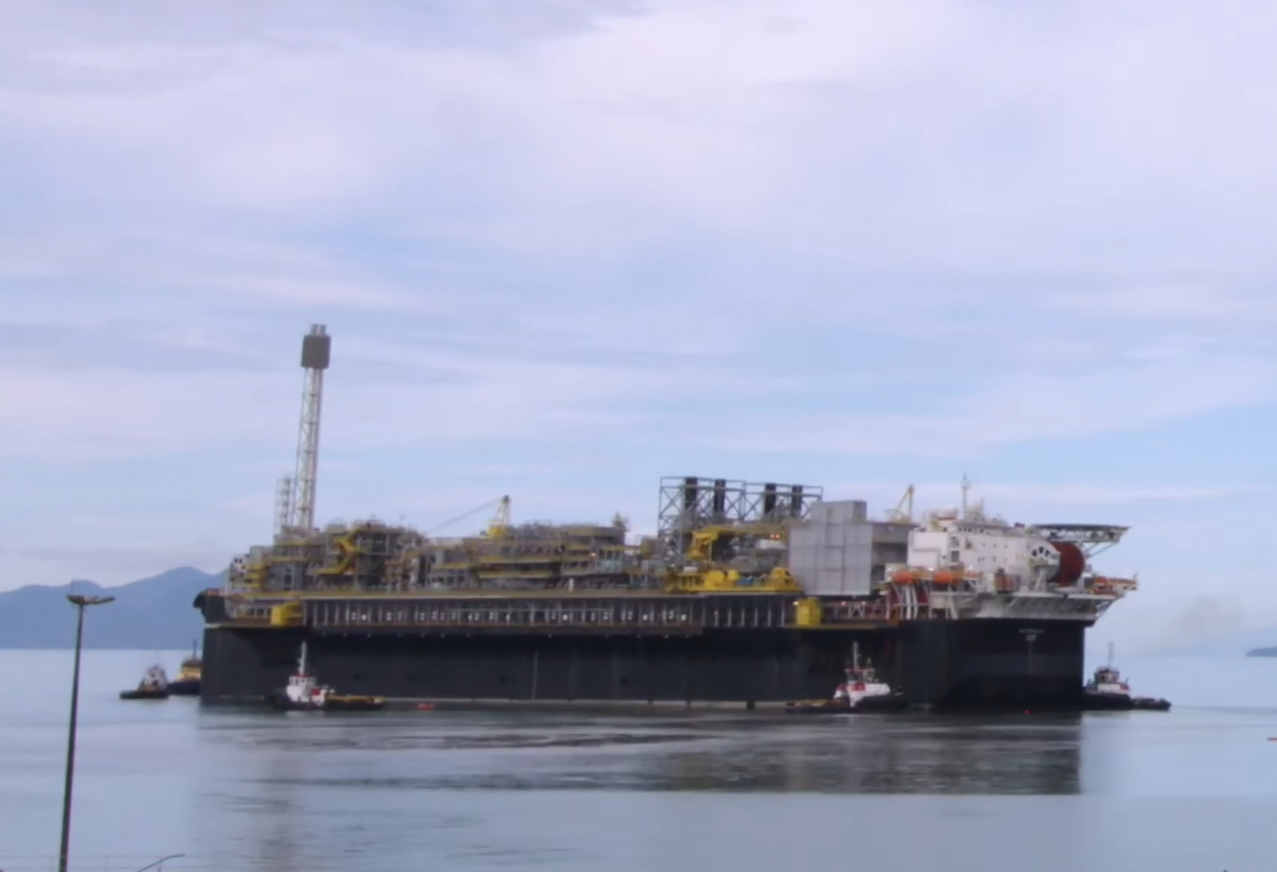
Image Source: Youtube: Offshore, Maritime and Energy - FPSO Petrobras 66 - Sailaway - Time Lapse. (All rights belong to the original owner.)
Production: Oil
Operations start: 2017
Water depth: 2150 m
Country: Brazil
Block: Tupi Field
Type: FPSO
Field
Lula South forms part of the giant Lula field on the Santos Basin Outer High. Hydrocarbons occur beneath the thick Aptian Ariri salt in Lower Cretaceous lacustrine carbonates, principally the Barra Velha Formation. The accumulation is a supergiant pre-salt oil-and-gas system developed in discrete modules, each using subsea production and injection wells tied to a dedicated deepwater FPSO for processing, storage and export.
Facilities
P-66 was designed for ten subsea production wells and eight subsea injector wells. Standardised subsea trees, manifolds, flowlines, risers and umbilicals connect the well system to the vessel. Incoming fluids are separated into oil, gas and water. As the first operating member of the pre-salt replicant series, its oil plant uses a single treatment train comprising a free-water knock-out vessel followed by two electrostatic treaters, providing dehydration and desalting before crude enters the cargo tanks. The gas plant gathers separator and vapour-recovery gas through main compression, molecular-sieve dehydration, Joule–Thomson hydrocarbon-dew-point control and membrane removal of carbon dioxide. Treated gas can then enter export compression, fuel-gas service or reservoir-injection compression; the carbon-dioxide-rich membrane stream is also configured for compression and subsurface reinjection. Integrated water-treatment and water-injection facilities serve the injector network. The standard electrical arrangement uses four gas-turbine generator packages in a three-operating, one-standby configuration, supporting processing, compression, injection, marine and accommodation loads. The 288-metre-long, 54-metre-wide hull contains about 1.6 million barrels of crude storage. Oil is retained in the cargo tanks between lifting operations and transferred to visiting tankers. The gas plant provides pipeline-export and reservoir-injection routes. The vessel’s modular topsides, standardised hull, subsea interfaces and deepwater station-keeping arrangement define the replicant concept applied specifically to P-66.
Similar Assets
News