P11-B-De Ruyter
P11-B-De Ruyter is a fixed steel Gravity Base Structure (GBS) production platform in Blocks P10a/P11b of the Dutch Southern North Sea, installed and first producing in 2006. It handles oil and associated gas production, with oil stored in the GBS and exported via a Tanker Mooring and Loading System (TMLS); gas exports to shore via pipeline networks.
Operator: Dana Petroleum Netherlands B.V.
Status: Operational
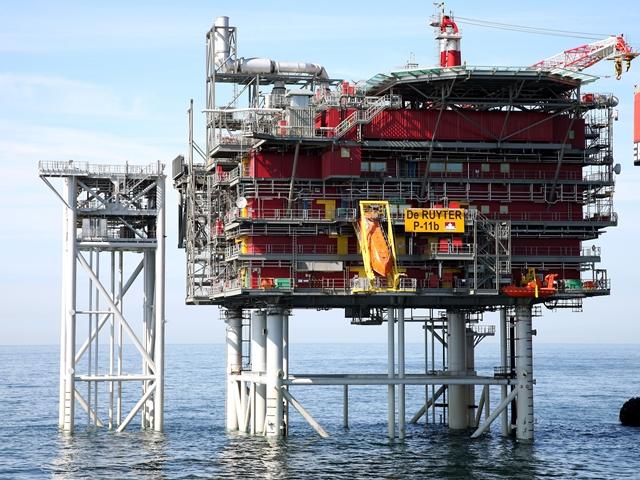
Image Source: Dana Petroleum Netherlands B.V.. (All rights belong to the original owner.)
Production: Oil
Operations start: 2006
Water depth: 35 m
Country: Netherlands
Block: P-Block
Type: Gravity-based concrete
Field
The De Ruyter field is a conventional oil and gas field in Dutch North Sea Blocks P10a and P11b, discovered in 1996 and developed for production in 2006. It produces primarily oil with associated gas from reservoir units such as Volpriehausen sandstone and related stratigraphy. The field forms a hub for nearby subsea developments (e.g., Medway), with integrated surface infrastructure.
Facilities
P11-B-De Ruyter's facilities centre on a robust GBS with an integrated production deck that supports oil separation and storage, gas handling, produced-water treatment, and power generation. Oil from multiple wells is processed, stabilized and temporarily stored within the GBS before periodic export via a TMLS to shuttle tankers. Gas from the field is compressed and exported via an ~8-inch pipeline to the TAQA operated P15-D platform, and onward into onshore gas networks. Subsea tie-backs such as Van Nes and Van Ghent have been developed via subsea flowlines and control umbilicals, integrated into De Ruyter's processing system as part of the Medway development. The recent Unity project (P11-Unity) adds a minimum-facilities wellhead platform tied back for gas from Witte de With and Van Ghent East, routed to De Ruyter. Topside utilities include power generation (typically diesel/gas turbines), produced water and hydrocarbon handling, safety and fire systems, flare and vent systems, and accommodation modules. The GBS design provides stability in ~33-34-m water depth; stable features include subsea control systems, export metering, and robust structural integrity measures for long-term operation.
Similar Assets
News