


Type:
Gas
Facility:
Production
Water Depth:
20
Installed:
1995
meters
Block:
48/12
Design:
Fixed steel
Sub Structure:
315
Topsides Wgt:
351
tonnes
tonnes
Intro
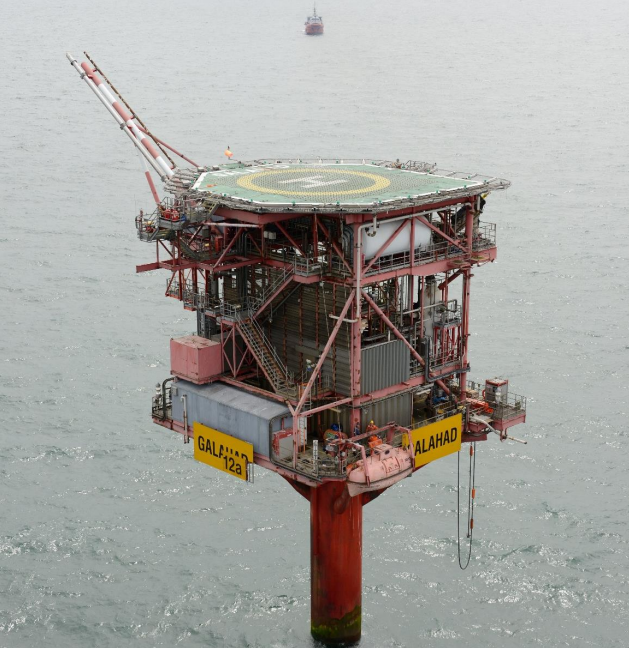
Galahad was a normally unattended offshore gas production platform in UK Southern North Sea Block 48/12a, installed in 1995 to produce conventional natural gas. A monopod steel structure supported minimal topsides. Gas flowed via a dedicated 12-inch subsea pipeline to the Lancelot Area Production System (LAPS) for export to the Bacton Gas Terminal. The wells were plugged and abandoned in 2021 and decommissioning commenced in 2025.
Field
The Galahad gas field is a conventional Rotliegend/Leman Sandstone gas accumulation in the Southern North Sea, discovered in 1975 and developed through horizontal drilling and unmanned platform technology. Production began in 1995 with multiple wells tied into the LAPS export network. It formed part of the Arthurian gas fields cluster, with gas exported into UK infrastructure until economic cessation.
Facilities
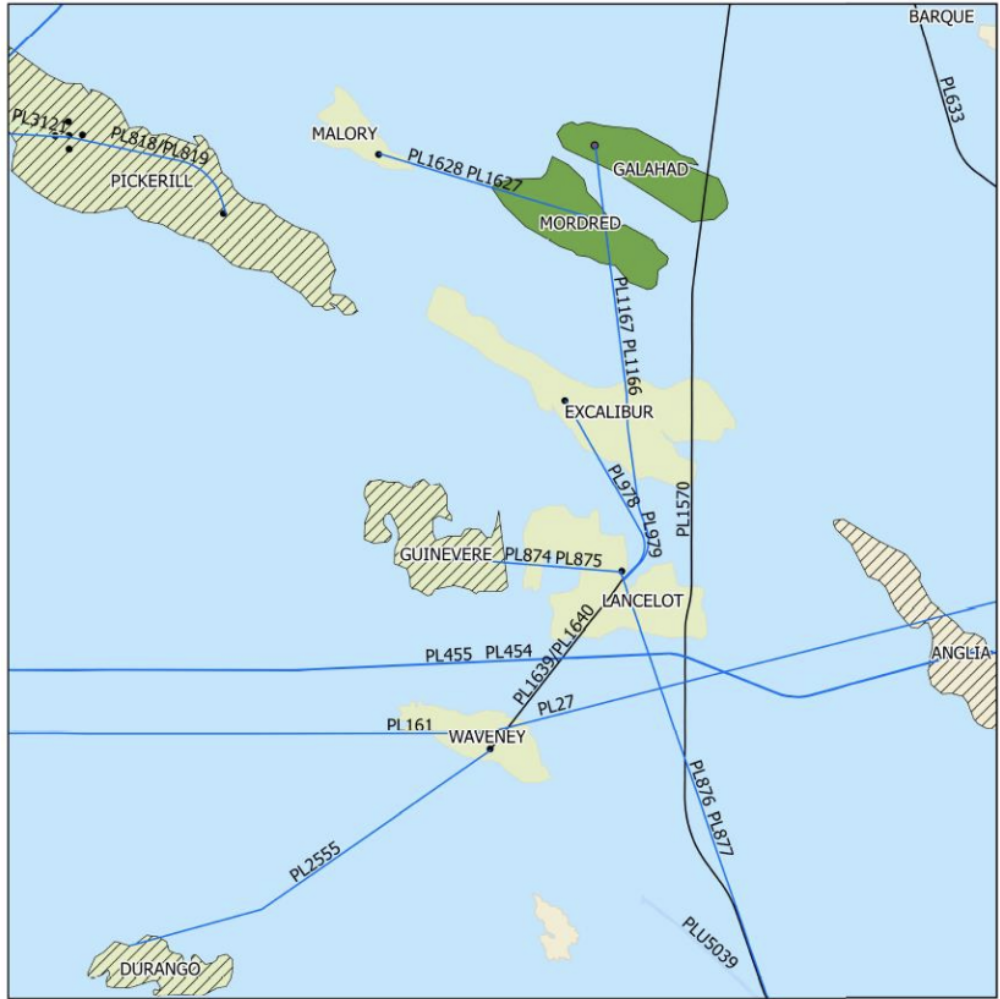
Galahad comprised a single monopod support structure with an integrated topside containing minimal production systems designed for satellite operation; it was normally unattended. Well fluids from the three production wells were gathered on the platform and flowed into a dedicated subsea pipeline connection to the Lancelot Area Production System (LAPS). There was no significant on-platform separation, compression, dehydration, or export conditioning — these functions were performed downstream via the LAPS infrastructure and associated hubs (e.g., Lancelot, Excalibur, Malory) before reaching the Bacton Gas Terminal. Topside equipment consisted of well manifolds, flowlines, remote control interfaces, metering points, instrument air, emergency shutdown systems, and safety instrumentation sized for unmanned operations. Power distribution was sufficient for monitoring and control, with reliance on subsea umbilical communications where applicable. Chemical injection points (for corrosion/hydrate control) supported flow assurance to the export system. Structural design was a monopod jacket with four piles tailored to shallow Southern North Sea depths (~19-m), reducing steel tonnage and offshore footprint. After cessation of production, the wells were plugged, the topside made hydrocarbon safe, and the asset entered a decommissioning programme commencing in 2025 with heavy lift removal operations.
Similar Platforms




SUBMIT YOUR STORIES AND PHOTOS
RigOil is built on the stories of the people who lived and worked offshore. If you have photos or memories from life on a North Sea platform, we’d love to include them in the archive.
Upload your photos and help preserve this shared history.*
*By submitting content, you confirm you have the right to share it and grant RigOil a non-exclusive, royalty-free licence to use the material for editorial, promotional, and commercial purposes. Copyright remains with the contributor.